The question everyone is asking
If you work in PR right now, there's a good chance someone - a client, a stakeholder, a senior leader - has turned to you and asked some version of this question:
"How do we show that our coverage is impacting AI?"
It's a fair question. AI chatbots like ChatGPT, Claude, and Gemini have become a routine part of how people find information, research products, and make decisions. And if that's where your target audiences are going to learn about the brands and businesses you represent, it's reasonable to want to know whether your media coverage is showing up there - and whether it's making a difference.
The good news is that it absolutely can. And the even better news is that you can measure it - without needing to be a data scientist or an AI expert.
This guide walks you through the AIMS framework: a step-by-step approach to measuring the AI impact of your PR campaigns. We'll explain the principles, walk through each step, and show you how to use it in your reporting.
Introducing AIMS
AIMS stands for AI Impact Measurement Scale. It's a four-step framework that takes you from understanding your target audience all the way to scoring how likely your coverage is to be used by an AI chatbot.
The word AIMS is also a useful reminder of the approach: you start with the aims and objectives of your target audience - what do they want, what are they trying to find out, why are they going to AI chatbots in the first place? That thinking anchors everything else.
Audience
Who are you trying to reach, and what do they need?
Inputs
What will they type into an AI chatbot?
Model
How does the AI personalise and shape responses?
Source
Will your coverage be selected as a source?
The first three steps - A, I, and M - work together to generate something we call the Campaign-Audience Prompts (CAP): the specific set of prompts that real people in your target audience are likely to ask an AI, in the context of your campaign. The fourth step - S - is where you measure how likely your coverage is to actually be used.
Let's walk through each one.
Audience
The starting point is always your audience - but not your general company audience. This is about the specific group of people you are targeting with this particular campaign.
This might already be well-defined in your campaign strategy. If so, great - you're ahead of the game. If not, it's worth taking the time to think it through properly, because everything else in the framework flows from here.
Who are they?
Start with the basics: demographics, behaviours, and context. Let's use an example that runs throughout this guide: imagine you're working on a campaign to promote Netflix's gaming service to casual gamers.
Your target audience might look something like this:
Demographics: Age 18–45, mixed gender, urban/suburban, a mix of singles and young families
Behaviours: Plays games occasionally on mobile or TV - not a hardcore gamer; uses their phone or TV as their main entertainment device
Mindset: Not deeply engaged with gaming culture; open to trying something casual and accessible
What do they need?
Once you know who they are, define what they actually need - specifically in relation to the campaign objective. These are the real-world desires, concerns, and questions that drive their behaviour.
For our Netflix gaming example:
A way to play casual games without buying expensive hardware
An affordable option - ideally something they already pay for
Something fun and accessible with no steep learning curve
Variety - a decent library to dip in and out of
Convenience - playable on devices they already own
Reassurance that it's worth trying
What tasks will they undertake?
From those needs, think about the specific tasks your audience will want to do to address them. These are the jobs-to-be-done that lead someone to reach for a chatbot:
Find out if they already have access
Discover what's available
Compare options with other services
Get personalised recommendations
Figure out how to get started
Assess value for money
Check device compatibility
Quick tip
Most of this thinking will already exist somewhere in your campaign plan. You don't need to start from scratch - you're just bringing it into focus through the lens of "what will this person do when they open a chatbot?"
Inputs
Now that you know who your audience is, what they need, and what tasks they're trying to accomplish - you can think about what they will actually type into an AI chatbot.
This step is about generating a set of realistic, representative prompts. But here's something important to understand upfront: AI prompts are nothing like Google searches.
People don't type "Netflix gaming" or "streaming service games" into ChatGPT. They ask full questions, often with personal context, in natural conversational language. They provide background. They explain their situation. They ask follow-ups.
What prompts look like in the real world
Taking our Netflix gaming audience and their tasks, here are the kinds of prompts they might actually type:
“Do I need to pay extra for Netflix games, or is it included in my standard plan?”
“I keep hearing that some streaming services now include games - which ones do, and what kind of games are they?”
“I already pay for Netflix and I'm wondering if there's any point getting Apple Arcade on top of that, or whether Netflix games would be enough for someone who just wants something casual to play in the evenings?”
“I enjoy fairly simple puzzle and word games and I only really have about twenty minutes here and there to play - are there any games on Netflix that would suit that kind of casual approach?”
“I've just found out Netflix has games but I have no idea how to find them - do I need a separate app or is it built into the normal Netflix app?”
“I'm looking for some games me and my kids can play together on the TV on a Friday night - nothing too complicated, just something fun. Do any of the streaming platforms we might already have include that kind of thing?”
Notice how specific, personal, and context-rich these are. That's the nature of AI prompting - and it's important to capture that when you're building your list.
How many prompts do you need?
More is better, but aim for quality over quantity. You want a range that covers the different needs and tasks you identified in the Audience step. A well-spread set of 10–20 prompts is far more useful than 50 variations of the same question.
Model
Each AI chatbot - ChatGPT, Claude, Gemini, Perplexity - is powered by its own AI model. And there are differences, not just between platforms, but within them: ChatGPT has several versions, and people use different ones.
More importantly: even when two different people type the same prompt, they may get different answers. That's because the AI model knows things about each user - from previous conversations, preferences they've shared, and contextual signals like their location or the time of year.
A simple example
If you ask an AI chatbot to recommend a good restaurant in Canary Wharf, and it knows from your previous conversations that you're vegetarian, have young children, dislike chain restaurants, and are asking in the middle of summer - it's going to recommend something quite different from what it tells your colleague, who has an entirely different profile.
The Model step is a reminder that the prompt your audience types is not the full picture. The AI takes that prompt and layers in personal context before deciding how to respond - and which sources to draw on.
What this means for your prompt list
You can't fully predict the personal context the model will add. But you can make sure your prompt list captures a wide enough range of situations and angles that it reflects the real variety of ways different people might ask the same underlying question. Variety in your prompts = better coverage of the real world.
The Campaign-Audience Prompts (CAP)
Once you've worked through Audience, Inputs, and Model, you have what we call the Campaign-Audience Prompts - or CAP for short.
The CAP is your working list of prompts: the specific questions that real people in your target audience are likely to ask an AI chatbot, in direct relation to your campaign objectives. It's where three things overlap:
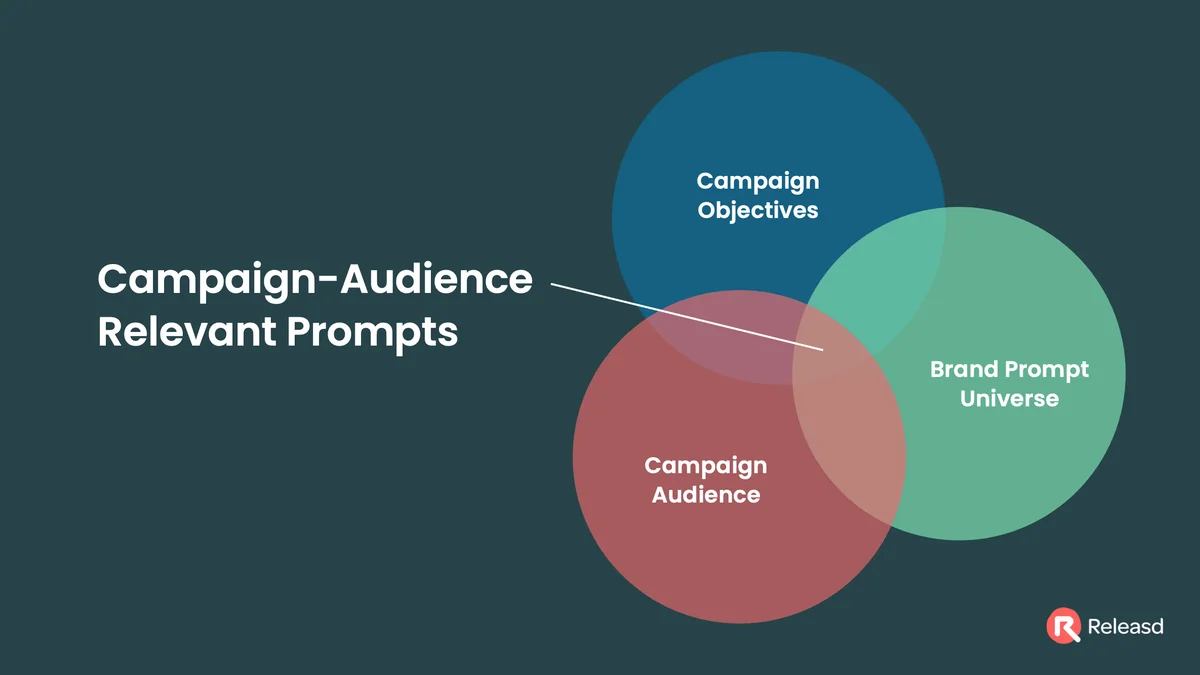
It's worth noting what the CAP is not: it's not every possible prompt anyone could ever ask about your brand. Every brand has what we call a Brand Prompt Universe - the vast and ever-expanding range of questions people might ask AI about them. If you work in PR for Netflix, that includes everything from account settings and payment questions to share price queries and content scheduling.
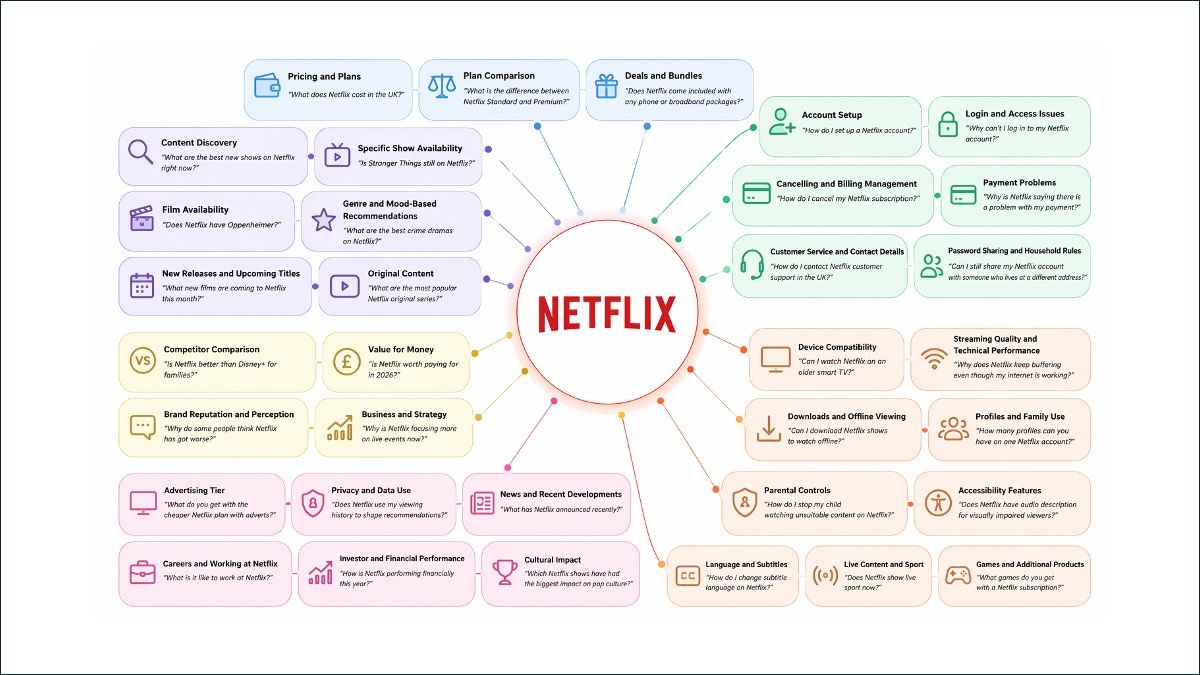
The Netflix Brand Prompt Universe — the full range of prompts people might ask an AI about Netflix
Your CAP is a focused subset of that: only the prompts that are genuinely relevant to this campaign, for this audience. Everything outside that is interesting, but it's not what we're measuring.
Branded vs non-branded prompts
One important distinction to build into your CAP: not all prompts mention the brand by name. Some people will search for your brand by name; others won't know it exists yet. Both types matter, and they map to different stages of the customer journey.
Non-branded prompts
Used by people who don't yet know your brand or product exists. They're searching broadly for a solution to a problem.
"Do any streaming platforms include games with a subscription?"
Branded prompts
Used by people who already know the brand - perhaps because they read your media coverage - and are now evaluating it.
"Are Netflix games automatically included in my plan?"
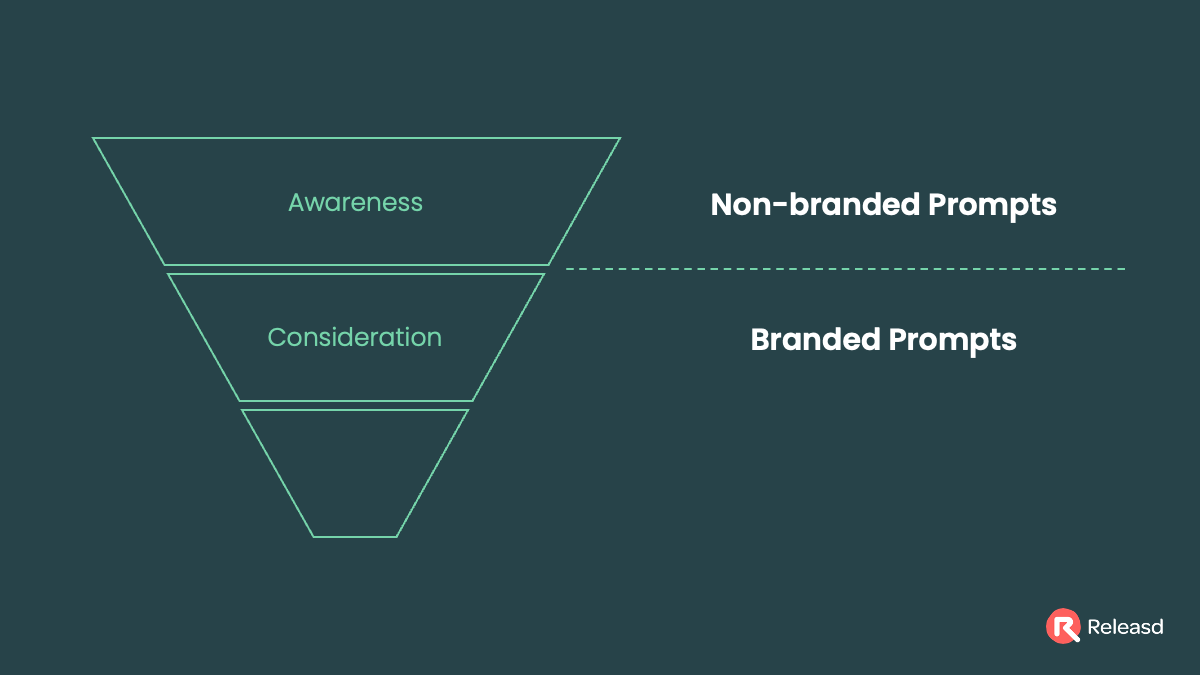
Branded and non-branded prompts map to different parts of the customer journey
Both types should be in your CAP. Non-branded prompts reflect the early, discovery phase - where good coverage can introduce someone to your brand for the first time. Branded prompts reflect the consideration phase, where they're actively researching before making a decision.
What does success look like for each type?
It's worth being clear that success means something different depending on which type of prompt you're looking at.
For branded prompts, success is your coverage being used as a source in the AI's response - the article is cited or drawn on to answer a question about your brand or product.
"Are Netflix games free with my subscription, or do I need to pay extra?"
The AI answers using your coverage as a source - citing a review or news article about Netflix's gaming offering that you secured.
For non-branded prompts, the AI uses your coverage as a source to answer the question - and because the question is specifically about the problem your campaign addresses, your brand gets mentioned or recommended in the response.
"What streaming services include games as part of their subscription?"
The AI draws on your coverage to answer the question, and in doing so recommends Netflix as an option.
That distinction shapes how you write non-branded prompts. A useful test: ask yourself "what could someone in our target audience ask an AI, where the right answer would naturally include our brand?" Those are your non-branded prompts. If the answer to the question wouldn't logically mention your brand at all, the prompt probably belongs outside your CAP.
Remember: AI hasn't replaced everything
It's worth keeping perspective here. Daily Google search volumes still dwarf the number of AI prompts. People still read media coverage directly, share articles on social media, and visit trusted news sources. Your coverage generates value at every stage - AI is an increasingly important channel, but not the only one.
Sources
You now have your CAP - a focused, representative set of prompts your audience is likely to ask. The final step is the most important question: how likely is it that your coverage will actually be selected as a source when an AI responds to those prompts?
This is where we move from planning to measurement. And to understand it, we need to understand how AI models find and choose their sources.
Factor 1: Visibility
Before anything else, can the AI even find your coverage?
Publishers decide whether they want AI bots to be able to read their content, and they communicate this via a file called robots.txt (you can see any site's version by adding /robots.txt to the domain). Some publishers welcome AI crawlers; others block them entirely.
Visible to AI
The publisher allows AI bots to crawl their content. The AI can read the article and potentially use it as a source. Some publishers are actively optimising their content to be AI-friendly.
Blocked from AI
The publisher has blocked AI bots. The AI cannot access the content at all. No matter how good the article is, it will have zero AI impact.
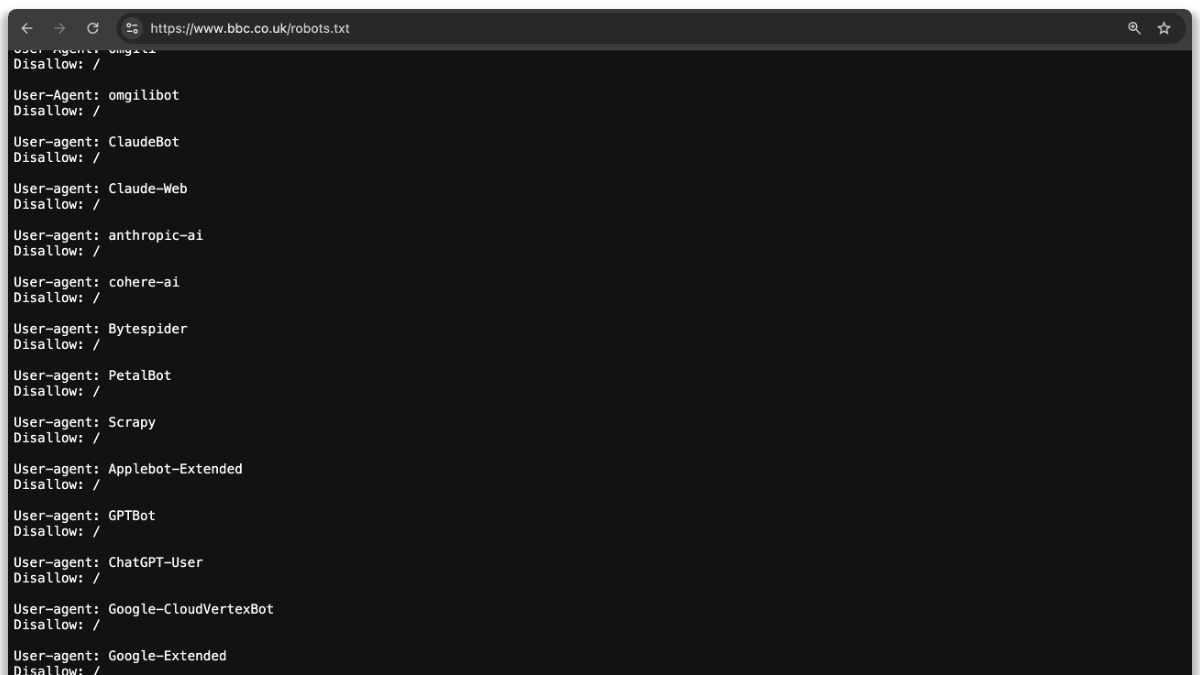
An example of a robots.txt file from bbc.co.uk.
This isn't always binary - some sites allow some AI bots but not others. And it's not a permanent judgement on the value of coverage: an article that is blocked by AI can still drive awareness, get shared on social media, and influence readers who then go on to use AI chatbots further down the funnel. But for the purpose of measuring AI impact specifically, blocked coverage scores zero.
Over time, knowing which publishers allow AI crawlers can genuinely inform your media strategy. Where you have a choice, publications that are open to AI bots will deliver more measurable AI impact.
Factor 2: Specificity
Assuming your coverage is visible, the next question is: is it the right kind of source?
Specificity /ˌspɛsɪˈfɪsɪti/
The state or quality of being exact, particular, and clearly defined.
AI models are answer engines. When someone asks a question, the model is looking for the best possible source - and it has access to up to eight billion indexed web pages to choose from. Your media coverage is competing with all of them.
The principle is simple: a source that contains detailed, trusted, clearly written information - capable of specifically answering the question being asked - will win out over one that is vague, generic, or unreliable.
There are several content factors that determine how likely a piece of coverage is to be selected. Here are the most important ones:
Topical Match
The article is directly about the same entity, product, event, or issue as the query. It matches the right time period, geography, and industry - and addresses the actual question being asked, not just the general subject area.
Passage-level Match
A specific paragraph or section directly answers the question. AI models can identify answer-bearing passages within long articles - so having a clear, concise section that addresses a question cleanly is a significant advantage.
Freshness
For time-sensitive queries, recently published articles are strongly preferred. A clear, accurate publication date - both visible on the page and in the site's technical markup - signals freshness to AI bots.
Originality
Original reporting, exclusive facts, first-hand interviews, unique data, or on-the-ground reporting significantly boosts a source's appeal. AI models favour content that provides something no one else has.
Trust and Authority
Strong editorial reputation, a track record of accuracy, clear ownership and editorial standards, and a history of being cited by other trustworthy sources all contribute to how much an AI trusts a publication.
Clarity and Extractability
A clear headline, a strong opening paragraph that states the key fact, named people and places, good attribution, minimal waffle before the substance - these make it easy for an AI to extract a clean, usable answer.
Structure and Formatting
Clean HTML structure, readable paragraphs, well-formed headings and lists, and useful links to supporting evidence all help AI bots navigate and understand the content.
Article Type
Different article types suit different prompts. Hard news is best for factual and timeline queries; explainers for context and background; launch articles for "what was announced?" queries; reviews and buying guides for evaluative and comparison prompts.
From criteria to score: how does it actually work?
It's a fair question. A list of eight criteria is useful context, but it doesn't tell you how to turn an article into a number.
At Releasd, we've built a scoring framework that automates this entirely. It uses AI to analyse the full text of each article and evaluate it against each of the criteria above, always in direct relation to a specific prompt from your CAP. Each factor is graded, the grades are weighted and combined, and the result is a single AI Impact Score per article per prompt. The underlying systems that drive this have taken a long time to develop and refine - but the output is fast, consistent, and comparable across campaigns.
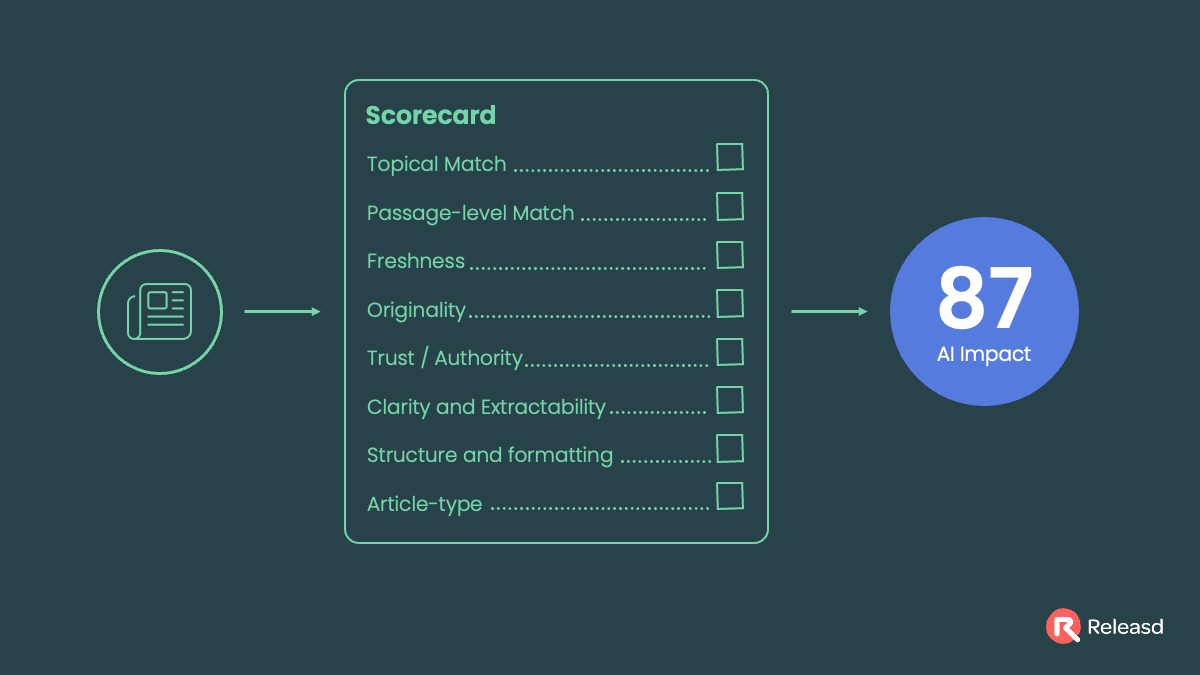
Our AI Impact "scorecard" grades the content of each article and combines them into a single AI Impact score
If you want to try a simpler version yourself, you can. Here's a practical approach using any AI chatbot:
- 1
Take one article from your campaign and one prompt from your CAP
- 2
Paste both into ChatGPT or Claude, along with the following:
- 3
Repeat for each article in your CAP, using the same prompts each time so the scores are comparable
Example evaluation prompt
"You are evaluating how likely an AI model would be to use the article below as a source when responding to the following user prompt. Score the article on each of these factors from 1 to 10: Topical Match, Passage-level Match, Freshness, Originality, Trust and Authority, Clarity and Extractability, Structure and Formatting, Article Type. For each factor give a score and a one-sentence explanation. Then give an overall AI Impact Score out of 100.
Prompt: your CAP prompt
Article: paste article text"
It's time-consuming at scale - which is exactly the problem Releasd solves - but for a handful of articles it's a useful way to get a feel for the framework in practice.
The AI Impact Score
All of these factors - visibility and the specificity criteria above - can be combined into a single score for each piece of coverage, measured against each prompt in your CAP.
The AI Impact Score
A score that measures how likely a specific piece of coverage is to be selected as a source by an AI model when responding to a specific prompt. The higher the score, the greater the likely impact.
The score takes into account both whether the coverage can be found at all (visibility) and how strong a source it is when compared to what else is out there (specificity). A blocked article scores zero. A highly visible, original, authoritative, well-structured article that directly addresses the prompt in question scores highly.
Using AIMS in your reporting
Once you've run your coverage through the AIMS framework - whether manually or with a tool that does it automatically - you have a structured set of scores you can turn into meaningful insights for clients and stakeholders.
Here's the kind of analysis the framework makes possible:
Coverage
- Which articles were visible to AI bots, and which weren't?
- Which pieces of coverage generated the highest AI impact scores?
- Which articles underperformed on specificity factors?
Publications
- Which publications drove the most AI impact overall?
- Which publications were invisible to AI - and should that affect future strategy?
- Where do the highest-scoring articles come from?
Prompts
- Which prompts in the CAP were most impacted by the campaign?
- Were those branded or non-branded prompts?
- Which topics and themes were well covered vs. underserved?
Campaign Score
- An overall AI Impact Score for the campaign
- A benchmark for future campaigns to measure against
- A data point that sits alongside other measures of PR impact
Used well, this gives you a clear, credible story to tell: not just "we got X pieces of coverage," but "here's how that coverage is shaping the answers your audience is getting from AI right now."